
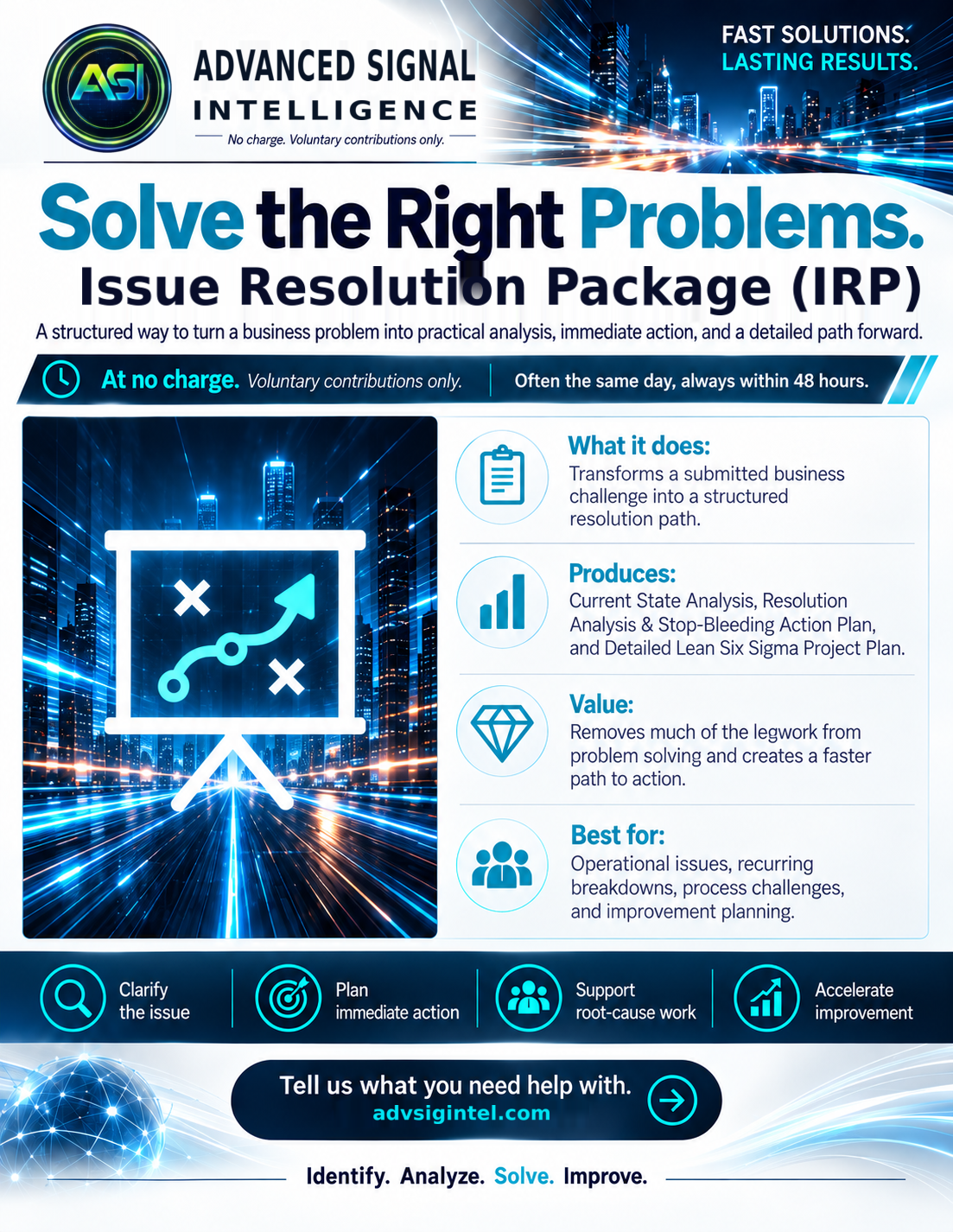
Pre-Project Analysis and Issue Resolution Package
Here are the benefits you get:
1. Current State Analysis
Less preparation and writing: Provides an organized assessment of the submitted problem, performance gap, process weaknesses, and evidence limitations.
Less investigative legwork to plan: Identifies specific records to obtain, questions to investigate, and checks needed to evaluate suspected causes.
More focused use of client time: Directs discussions toward issues such as purchasing delays, stock reservations, quality status, and delayed scrap transactions.
Less risk of pursuing the wrong cause: Separates suspected contributors from established findings and identifies alternative explanations.
Clearer client communication: The A3, baseline calculations, and current-state map provide a shared reference for explaining the problem and agreeing on scope.
2. Resolution and Stop Bleeding Plan
Less effort designing immediate actions: Supplies a proposed containment sequence with responsibilities, timing, and completion evidence.
Less coordination ambiguity: Defines shortage ownership, daily reviews, response deadlines, and escalation.
Earlier attention to threatened deliveries: Directs the team to check orders due within ten working days against usable materials and confirmed supply.
Easier improvement evaluation: Pairs proposed changes with tests, tradeoffs, and approval requirements.
Clearer explanation of the proposed future process: The future-state map gives the consultant a concrete design to review with the client.
Better protection against unintended consequences: Includes quality, inventory, allocation, and rollback controls to evaluate before implementing changes.
3. Detailed Lean Six Sigma Project Plan
Less project-planning workload: Provides a sequenced twenty-working-day investigation and pilot plan, followed by monitoring through day 90.
Less daily instruction writing: Specifies owners, inputs, actions, expected outputs, and acceptance criteria.
Less time explaining assignments: Team members have a written reference for what to do and what constitutes completion.
Easier progress reviews: Defined outputs and decision gates help the consultant identify incomplete work and decide whether to proceed or extend an activity.
Less avoidable rework: Measurement checks and cause-validation steps help expose weak evidence before the team commits to changes.
Easier transfer to client ownership: Includes training checks, control responsibilities, reaction rules, and follow-up requirements.
More consistent client presentation: Gives the consultant a detailed plan for explaining responsibilities, dependencies, and next steps. 03_Detailed_Lean_Six_Sigma_Proj…
Across the package: The consultant receives a connected starting point for assessment, immediate action, and project execution. This can free time for client engagement, observation, validation, and leading improvements.
Click on the “Submit Request” above, and enter:
Your Email
Your “Problem Statement”
or
Your Prospect/Client “Problem Statement”
No Tricks, No Gimmicks, And better yet, No Charge